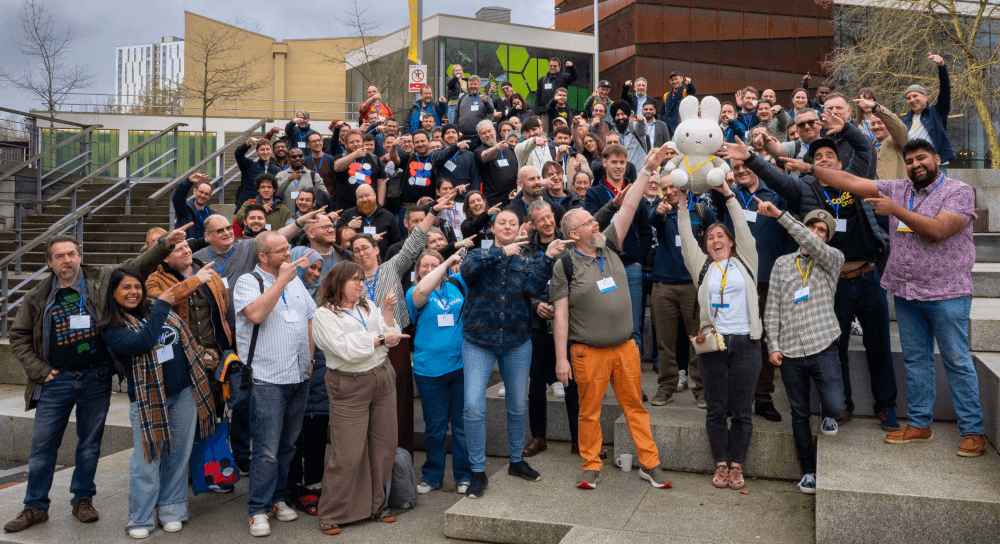
The weekend of 28th February to the 1st March saw the second DrupalCamp England event with around 100 people attending the University of Salford, not far from Manchester, for the two day event.
I had submitted a talk and the camp organisers had accepted it and also decided to make me a featured speaker, which was an incredible honour. As such I was part of the communications being sent out in the weeks before the event.
Since this is more or less a local event for me I decided to travel in on both days rather than get a hotel or anything. The rain and wind of the previous week had abated and the Saturday morning saw some of the warmest (and driest) weather we had seen in the north west for a few months.
Saturday
The keynote on Saturday morning was The Augmented Future: Winning with AI with Dr. Phininder Balaghan, founder of Traversally. This was an look through the current state of AI, which Dr. Balaghan said changes every time he gives the talk.
Most companies these days have adopted an agile methodology, which has taken about 20 years to become widespread. Since the introduction of LLM AI systems a few years ago we have seen massive adoption across all industries.
Dr. Balaghan joked that we have reached the age of AI-gile, the new agile methodology.
At the moment we are using a collection of LLM agents that work together in a so-called "agentic" system to provide a coherent service. The next true advancement in AI systems will be thinking AI systems that are able to properly think about the input and respond. I think we are quite a long way from that yet and no amount of processing power or RAM is going to solve the problem that LLMs are just statistical word engines.
What was interesting was that Dr. Balaghan asked the audience if anyone trusted AI, to which no one put their hand up. Despite many people in the audience making use of AI every day, we don't actually trust it.
After the keynote I spent so much time catching up with people that I accidentally missed the next session. It was good catching up with people though, some of which I hadn't seen for a number of years.
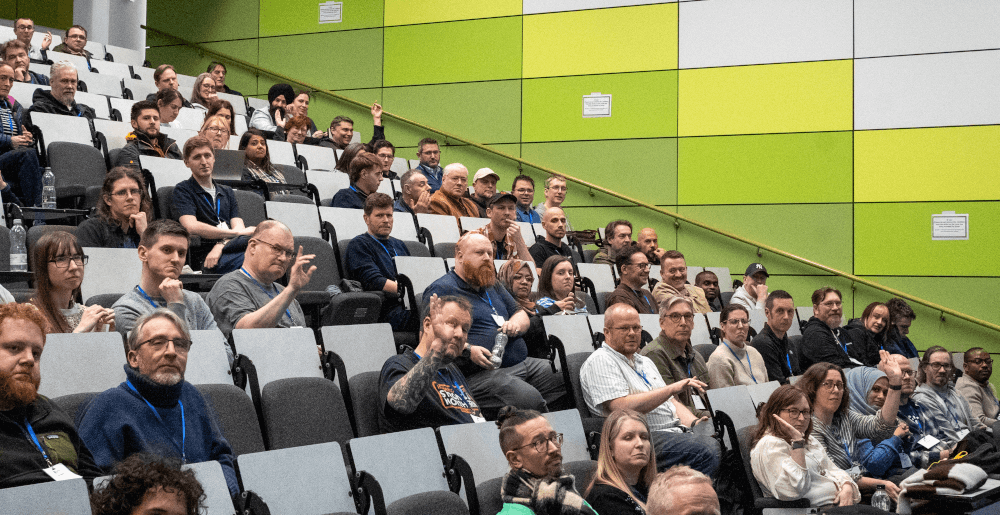
The next session was Using HTMX To Make Interactive Elements In Drupal, with me! I had thought long and hard about how to give this talk in the best way to teach people HTMX and Drupal in a single 40 minute session. From the feedback I received I think I did a good job. Lots of people thanked me for the talk and even said how good it was afterwards. If you came along to watch me talk then thank you very much!
Make sure you subscribe to the site and watch our social feeds for an article on HTMX and Drupal.
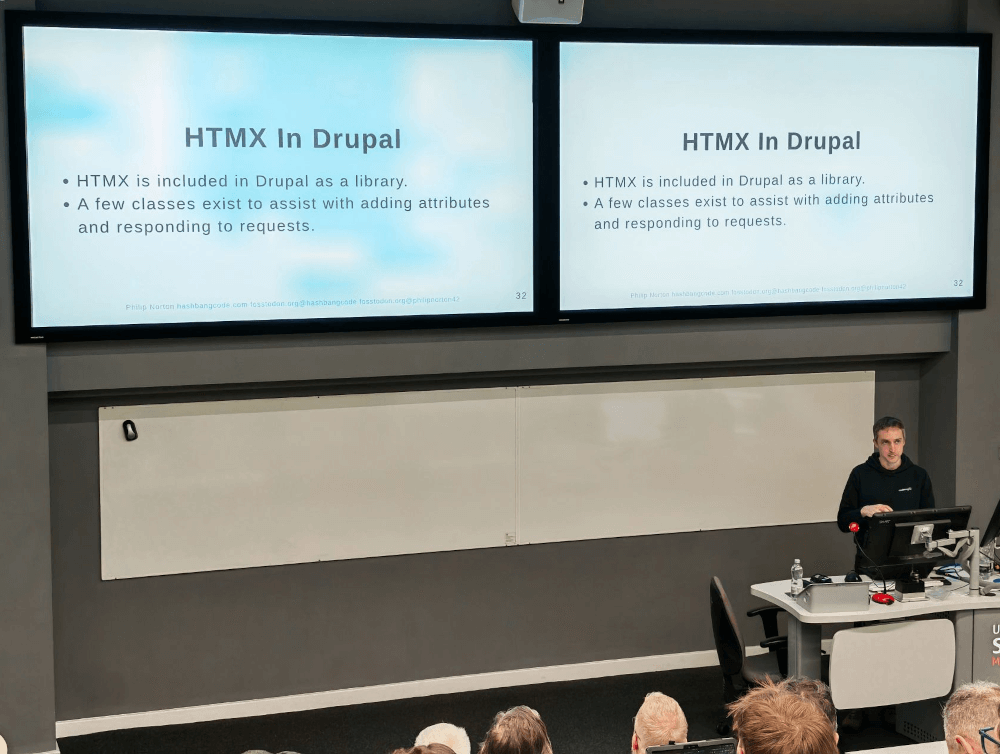
Thanks to Tawny Bartlett for taking some pictures of me during the talk and sharing them with me afterwards.
After lunch I went to see Emerson Reis talk about Scaling Drupal Multisite Deployments with GitHub Actions. Emerson looked at how to write GitHub actions and then added more and more complexity until he was able to deploy 600+ sites using a single, parallel processed, workflow. Really interesting stuff, and shows how you can automatically deploy large numbers of Drupal sites at scale. Apparently the entire process took just a few minutes.
Interestingly, Emerson also focused on how to save costs using this method. GitHub charge per minute for executing a workflow and the session had a few tips and tricks on getting the most out of the system.
Next was Speed up your site with Partytown with James Hall. Partytown is a JavaScript library that allows you to run third party scripts in a separate process, with the idea that you can speed up the key functionality of the site. The Partytown module integrates this system with Drupal and has a number of configuration options to alter what scripts are included in the Partytown process.
James has clearly had quite a bit of experience with the system and had some advice on how to get the most out of the module.
After a quick break I went along to listen to Emma Horrel talk about Drupal CMS: What’s here, what’s coming (and the UX behind it). Emma does an amazing amount of research and planning around the interface of Drupal (and by extension Drupal CMS) and this was a snapshot of the current state of that research and what the next steps are. She showed some of the planning being done about Drupal CMS 3 and 4 and what sort of timescales (and features) are expected in the future versions.
The final session of the day (not including the wrap up session) was Suspending Reality: PHP Fibers in Drupal Core and beyond with Steven Jones. This was an excellent introduction to Fibers in PHP and what exactly concurrency means, especially in a large application like Drupal. Steven introduced the concepts and built up to the speed improvements in Drupal 11.3.0. I really enjoyed this talk, crammed with technical detail and plenty of jokes.
After the camp was done for the day we headed off to BrewDog, on Peter Street for a drink and a chat.
There was a tab behind the bar and to prove we were part of the DrupalCamp group they gave us blue Lego bricks to hand over at the bar. This worked well, but you should have seen the face of the guy next to me as I asked for a drink and handed over a Lego brick as payment. I must have looked totally crazy!
It was a good evening and I got to have a good chat with some people I had only met virtually.
Sunday
Sunday morning started at 9am with breakfast at the venue. The food during the weekend was good and the staff on hand were very pleasant and welcoming.
The first session of the day started at 10am with Why Drupal remains a robust choice in today's AI era, which was a panel session session featuring Paul Johnson, Matt Summers-Sparks, Jamie Abrahams. This was a question and answer session where the group took turns in talking about how they have implemented solutions for clients using AI systems. An interesting discussion and it was more measured and nuanced than some of posts you might see on LinkedIn. They admitted that whilst AI was useful in speeding up processing and doing things automatically, having a human at the centre to make the final call was essential.
After that wrapped up a group of us headed off to another room to hold an unconference. This is where we decide on the schedule and subjects of the sessions for the rest of the day using post-it notes.
When just a handful of people showed up we decided to look at the LocalGov Publications Importer module as a group. Rupert (the module maintainer) talked us through how he built it and how the PDF processor works. We also had a look at a great little badminton application built in Next.js that Vijaya Chandran Mani had created.
After lunch we continued with the unconference and I had a question answer session about HTMX before we looked at an experimental feature for LocalGov Drupal that Tony Barker had been working on. The HTMX questions came from people who were in the talk and people who weren't and it was good to see a bit of enthusiasm about the subject from the community.
There were other things going on at the camp on the Sunday. Several students from the University were doing "Drupal In A Day" and a number of people were doing mentored contributions.
I was pretty tired after all the activities of the weekend and so I just chatted with a few people in the break area for an hour before heading home.
Overall, I'd say the camp was a resounding success. I learned a lot and it was really good to see some familiar faces that I hadn't seen in person for a few years. The Drupal community is really supportive of each other and there is a great deal of encouragement and enthusiasm for the tech.
There was a bit of a buzz around the subject of AI, but I think people are starting to realise that it isn't the panacea that some people are making it out to be. A few people I spoke to had encountered serious issues with AI and now keep it firmly within guard rails. There were a few examples (especially in the unconference) where people had used AI to create applications, but they used it as a tool, rather than a replacement for thinking and knowing the skills involved. I think that's important and that's reflected in the conversations and talks over the weekend.
Massive thanks to the organising crew behind the camp; there was clearly crazy amounts of effort put in for the weekend to run so smoothly. The team behind DrupalCamp England really put on an excellent event and I'm sure everyone felt welcome and well looked after.
Thanks to Paul Johnson for taking lots of pictures over the weekend, most of the pictures on this article are from his photo album from the event. He was even taking pictures during one of the session he was in.
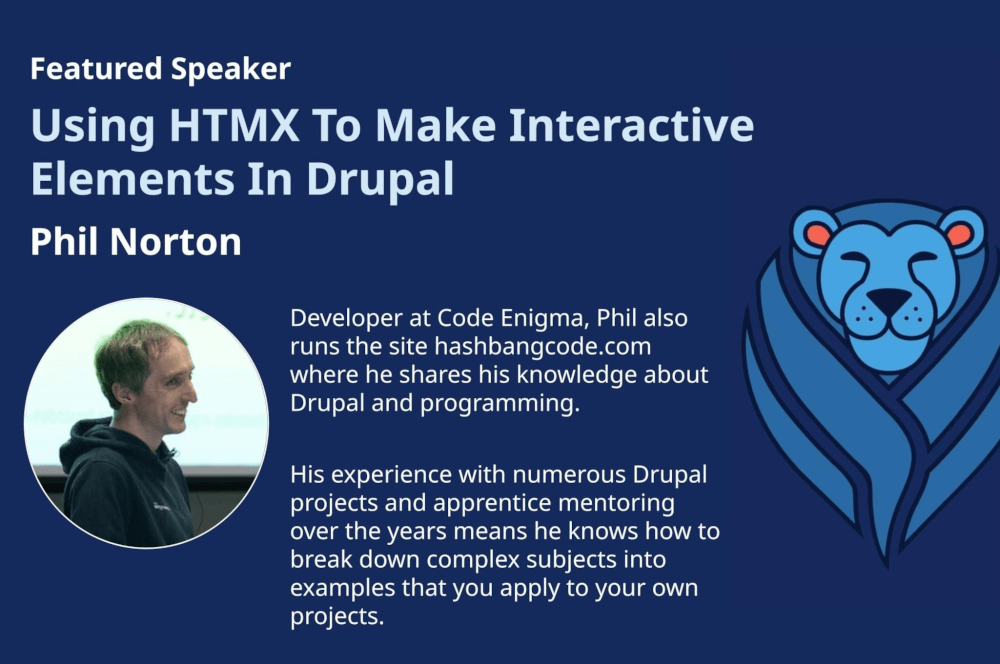
I was so amazed to be made a featured speaker for the camp, they even made me some banner images to advertise the event, which is shown here.
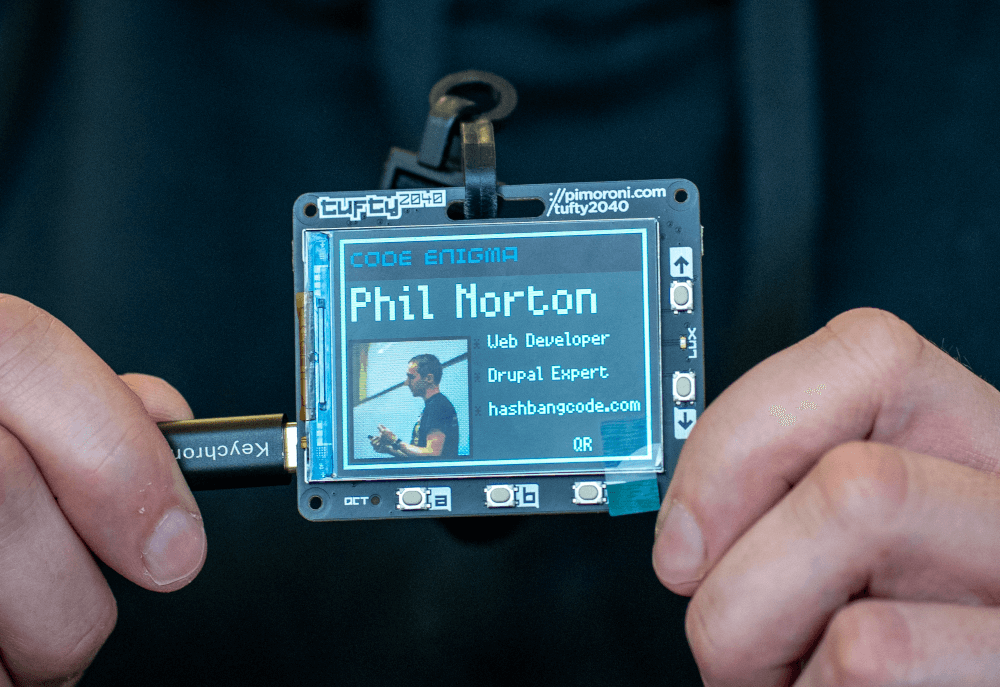
I took along an electronic name badge (a Tufty 2040) for the event, and that got a lot of interest as well. I'll have to see if I can put Doom on it for the next conference as several people asked that question.
Add new comment