PHP

Posts about the server side scripting language PHP

PHP Function To Work Out Factorial Numbers

Factorial of a number is defined as the product of the number and all of the numbers small than it. So if you take the number 4 the factorial of that number is 24 or 1 x 2 x 3 x 4.

Factorials are useful for a number of applications, for example when working out how many times a set of objects can be combined in different ways.

Use the following PHP function to work out the factorial of any given number. The first thing it does it make sure that the number is greater than 1 because the factorial of the number 1 is 1.

Get Fibonacci Numbers Using PHP

Fibonacci numbers not only have a few uses, but are also quite a nice little number sequence in themselves.

The sequence starts at 0, the next number is 1, and every number after that is the sum of the last two numbers. So the third number is 1, and the second number is 2.

To create this number sequence in PHP we need to create the first two items in the array. As we know that these are 0 and 1 we can create the array like this.

$fibarray = array(0, 1);

To create the third number we just add the first two numbers together.

$fibarray[2] = $fibarray[0] + $fibarray[1];

This can be continued for as much as we want if we add it to a loop.

for ( $i=2; $i<=10; ++$i ) {
 $fibarray[$i] = $fibarray[$i-1] + $fibarray[$i-2];
}

This will create an array with the following values.

PHP Script To Turn Image Into ASCII Text

Use the following snippet to convert any jpeg image into the equivalent image in ASCII format. It works by loading an image using the PHP GD2 library function ImageCreateFromJpeg() and then figures out the height and width of it. It then uses these values to loop through every pixel in the image and figures out the colour of that pixel. It uses this value to create a "span" element that uses the text colour of a # to change the colour of the text.

An additional time (and space) saver for this function is that it detects any pixels that are just off white and simply displays a &amp;nbsp; character instead.

Planet PHP

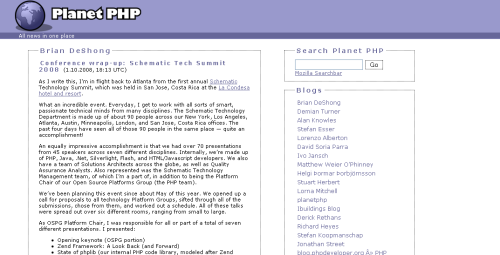
Planet PHP is a feed aggregator blog specifically for PHP related blogs. There are a good number of blogs that the site uses to update with so there is always plenty of stuff going up on the site. The site is not run by PHP, and is an independent project run by Christian Stocker and Tobias Schlitt.

Manage MySQL Databases With phpMyAdmin

The good thing about this site is that it saves having to go through all of the blogs in turn to see what is interesting in the world of PHP. If you run a PHP blog you can submit your site to the list and get your articles included in the updates.

Simple Swear Filter In PHP

Use the following function to filter out words from user input. It works by having a pre-set array of words that are to be excluded, this array is then looped through and each item is used to replace any instances of that word within the text. The regular expression uses the \b character class, which stands for any word boundary. This way you don't get the middle of words being filtered out when they are not meant to be.

By using the e of the preg_replace function it is possible to run PHP functions within the output. In this case we count the number of characters found in the replace and use this to create a string of stars (*) of equal length.

Search Engine Spider Detection With PHP

Part of any search engine optimisation strategy should always be that the user and the search engine see the same thing. If you start delivering different content you will either end up not performing or just getting outright banned. However, there are certain circumstances where you will want to detect the presence of a search engine spider. For example, let's say that you had a link to a section of your site, and you wanted to add a counter to it that registered an action every time a user clicked on the link. One way of doing this would be to add a parameter to the URL of the link, if the parameter is present then it is a user going through the site and so the action will be registered. You don't want to register every time a search engine bot spiders the site so using the following function will allow you to turn off this parameter for these spiders.

Directory Iteration With DirectoryIterator() In PHP 5

The normal way of looping through a directory is to get a handle on the directory, then go through each item, making sure that the file is readable and is not "." or ".." before doing something with the file. Because this is done a lot the DirectoryIterator() object was created in PHP5 to simplify this process.

The constructor of the DirectoryIterator() object takes a single parameter, this is the path of the directory that is to be iterated over.

$dir = new DirectoryIterator('/');

To get the current working directory you can use the PHP function getcwd(). This will return the directory that the PHP script is being run from.

$dir = new DirectoryIterator(getcwd());

The previous bit of code will open up the root directory of your server. If you are on a Linux server you will see directories like dev, var, srv, etc, lib, home, root, sbin and usr.

What To Do When get_html_translation_table() And htmlspecialchars() Doesn't Work

I found a little problem today when processing a bit of text from a non-english site. I found that the text was being loaded properly, but because it was in UTF-8 encoding PHP couldn't use htmlspecialchars() or apply get_html_translation_table() to the string to properly encode the foreign characters. These methods just don't have any effect. This is because PHP (before version 5.2.x) doesn't natively support unicode character encoding and is therefore not able to translate characters in UTF-8 format.

To get around this just use the utf8_decode() function on the string to convert it into a usable format.

Work Out Size In Bytes Of A PHP String

I found this very handy function on the php.net site in the user comments for the strlen() function. It accepts a string in ASCII or UTF-8 format and finds out how long that string is in bytes.

The function works by going through the string and adding how many bytes each character represents. For normal ASCII values this is a single byte so 1 is added to the total. Unicode characters can be up to 6 bytes and so the rest of this function works out how many bytes the character takes up by using AND calculations.

Connect To FTP Server Using PHP

FTP connection functions have been built into PHP since version 4 and make transferring files through FTP very easy.

The main function involved is called ftp_connect() which takes a FTP host as a parameter and attempts to connect to it. The port and a timeout limit can also be added to the function if needed.

Once a connection has been made then the ftp_login() function is used to attempt a login. This function returns true on success and false if it fails. The following snippet of code will attempt to connect and login to an FTP server, if any step fails then the code will print out a message saying so.