PHP

Posts about the server side scripting language PHP

Remove Duplicate Entries In A PHP Array

Use the following function to remove all duplicate values in an array.

function remove_duplicated_values($array){
 $newArray = array();
 foreach($array as $key=>$val){
  $newArray[$val] = 1;
 }
 return array_keys($newArray);
}

The way this function works is by looping through the array and assigning each value of the array to be a key of a new array and setting the value as 1. As the values of the array are added to the new array any new values will lengthen the array and any duplicate values will reset to be 1.

The keys of the new array are then returned as an array of values using the array_keys() PHP function.

Here is an example of the function in action.

Hiding HTML In Command Line PHP

Printing out stuff with PHP is basically essential to any program, but problems can arise if you want to use the same script for command line scripting and web site scripting because of the need to print out HTML. The $_SERVER super global array contains a variable called SERVER_PROTOCOL, which contains the protocol that the client is using to access the script. If the client access through the web then the protocol will contain something like "HTTP 1.1". If the script is being run from the command line then this super global variable SERVER_PROTOCOL would exist.

It would therefore be possible to print out HTML or new line characters depending on if the protocol variable exists. The following function can be used instead of the print() function to print out an HTML <br /> tag when the SERVER_PROTOCOL variable exists and new lines when it is not present.

Tidy Up A URL With PHP

Lots of applications require a user to input a URL and lots of problems occur as a result. I was recently looking for something that would take a URL as an input and allow me to make sure that is was formatted properly. There wasn't anything that did this so I decided to write it myself.

The following function takes in a URL as a string and tries to clean it up. It essentially does this by splitting is apart and then putting it back together again using the parse_url() function. In order to make sure that this function works you need to put a schema in front of the URL, so the first thing the function does (after trimming the string) is to check that a schema exists. If it doesn't then the function adds this onto the end.

Clean Up A Comma Separated List In PHP

Getting users to enter a list of items is a normal practice, but getting users to do it properly is sometimes a challenge in itself. Some users will put spaces in between the commas, others will not, some will even put a trailing comma at the end of the list.

Here is some code that can be used to clear up a comma separated list using some simple regular expressions. It works using the preg_replace() function, and by passing this function an array of options patterns and an array of replacements.

$list= trim($list);
$patterns[0] = '/\s*,\s*/';
$patterns[1] = '/,{2,}/';
$patterns[2] = '/,+$/';
$patterns[3] = '/^,+/';
$replacements[0] = ',';
$replacements[1] = ',';
$replacements[2] = '';
$replacements[3] = '';
$list= preg_replace($patterns, $replacements, $list);

Take the following string, entered by a user at 2 o'clock in the morning, whilst surfing the net drunk after coming home from the pub.

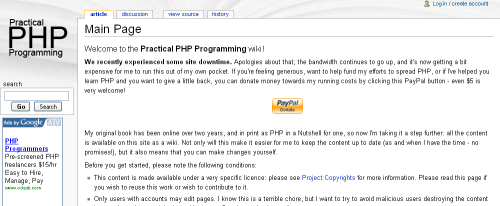
Practical PHP Programming An Online PHP Resource

Practical PHP Programming is a wiki site that has been set up to provide a central area for PHP developers to contribute to learning and understanding PHP. This site was recently called Hudzilla and was a pretty good online PHP book.Practical PHP ProgrammingPractical PHP Programming was a pretty good site when it was just static pages, people were always linking to it from the php.net site in order to explain something that wasn't clear in the documentation. I think that the decision to turn it into a Wiki can only lead to it becoming a better resource.
Add Effects To Images Using Image Filters With PHP

The imagecreatefromjpeg() function has been part of the PHP library since version 4, allowing programmers to load an image directly from a file. However, the imagefilter() has only been available since version 5 and adds a nice little set of effects to an already useful function.

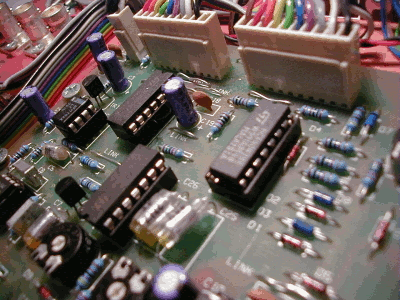
The effects are created using the function in conjunction with a set of constants. Take the following image taken from the free stock images site.

Default Electronics image

I chose this images because it has lots of colour and will show the techniques working well. To create the effects you need to use the following bit of code, in this case I am using the negative filter.

Printing Out File And Class Information In PHP

If you are debugging a PHP application then you might want more information than the values of some current variables. There are a number of built in magic variables that can be used to print out the file name, line number, class and method that the debug statement is printed out on. Here is an example that prints out some information from a class.

Overloading Functions In PHP

One thing that PHP doesn't allow is the creation of multiple functions with the same name. If you try this then PHP will give you a fatal error. Creating different functions with the same name is useful if you want to pass different parameters to a function that produces the same result. There are two ways around this problem.

The first is that you can pass the function an array of the items that you want. You can then use this array in the function to do whatever you want. For example.

Look At PHP Execution Times With PHP Benchmark

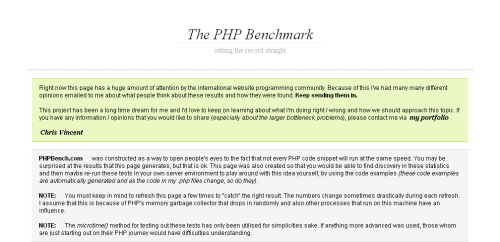
I have been doing a lot of benchmarking lately with regards to what is the most efficient way to program PHP. PHP Benchmark is a site that is dedicated to that single task.

phpbench.org

This site is in the early stages but looks very promising and deals with some of the major assumptions that programmers have about PHP, including the single and double quotes issue. I would say that most of the tests are only run a few times (around 1000) and so this doesn't give a full representative picture, but I look forward to seeing more from this site in the future.

Here are some links to my own benchmarking tests on #! code

Writing phpinfo() To File

The contents of phpinfo() are quite useful, and it is usually the first thing that many developers perform to make sure that PHP is installed. However, printing out the phpinfo() function can lead to a security risk because it displays a lot of information about the server.

Here is how to write the contents of the phpinfo() function to a file.

ob_start();
phpinfo();
$info = ob_get_contents();
ob_end_clean();
 
$fp = fopen("phpinfo.html", "w+");
fwrite($fp, $info);
fclose($fp);

This is an example of output buffering.