JavaScript

Posts about the client side scripting language JavaScript.

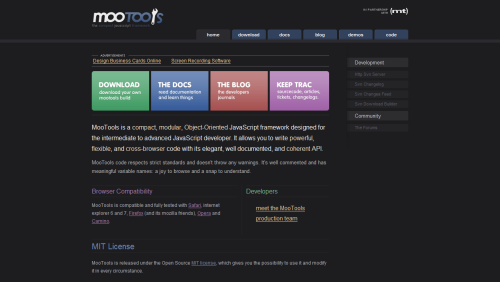
MooTools Home Page

If you are looking for information about the MooTools JavaScript framework then your first stop should be the MooTools home page. The site not only allows you to download MooTools, but it is also a great resource for learning how to use MooTools.

MooTools JavaScript Framework

There are examples of all the things you can do on the demo page, and information about all of the classes available in the framework on the documentation pages.

Using JavaScript To Run Form Events

Creating a form as part of an AJAX control is a common practice, but when you include a submit button within the form the default behaviour of the form is to redirect to the destination supplied in action. To run a form using JavaScript you need to include two things.

<form action="javascript:return false;" method="post" id="analysisForm" >

In order to overwrite the normal operation of a form you will need to replace the action attribute with some JavaScript code that returns false. This is can be done in the form of come in-line JavaScript code (commonly called a bookmarklet) in the place of any URL in the action attribute of the form.

Next, in order to actually get JavaScript to intercept the form submission action an onsubmit event is added to the form tag.

JavaScript Simple Loop Optimisation

When writing JavaScript applications I normally write for loops like this.

for (var i = 0; i < elements.length; ++i) {
  // loop...
}

There isn't anything wrong with this, but it is not an efficient way of doing things. All it takes is a little knowledge of what the for loop does every time it runs. The loop can be split into three sections like this.

Highlight Area With mootools

Creating a simple highlight effect is quite easy when you use the JavaScript framework mootools.

The first thing to do is grab the mootools library from the site and link it in your web page. You can select different components with mootools, but if you grab the whole thing you can start to play with whatever you want. Put this line of code in the head section of your web page.

<script type="text/javascript" src="mootools.js"></script>

For this example I want the highlight to occur when the page has finished loading. So I use the window.addEvent function to add an action for the 'domready' event to the window object of the page.

Generic User Agent Detection In JavaScript

Detecting the user agent in JavaScript can be important due to the way in which different browsers implement JavaScript. Sometimes it is necessary to create logic to do one thing in Firefox and another thing in IE. Luckily, all modern browsers support the navigator.userAgent property so that is a good start.

Because it is possible to mask your user agent in Opera it is necessary to detect this browser first. There are actually two different ways to hide the user agent in Opera. The default user agent is as follows:

Opera/9.23 (Windows NT 5.1; U; en)

It is possible to identify Opera as either Firefox or Internet Explorer. In this case the version of Opera is appended to the end of the user agent string so it is still possible to detect if the user has Opera and act accordingly.

Identify as IE

JavaScript Scrolling Box Marquee Replacement

Having a Marquee on a web page is a nightmare from an XHTML validation point of view, so here is a neat function that will produce the same effect as a vertical scrolling marquee, that passes XHTML validation, and built entirely from JavaScript and CSS.

Vertical Scrolling

Take the following HTML code. Don't worry about reading it. It is just 7 p tags (2 of which act as spacers) contained within a div tag.

Flashing JavaScript Text

Here is a simple function that makes text in a tag fade into one colour slowly before quickly fading back into the original colour. If the background is the same colour as the text then the text will appear to fade in and out.

JavaScript Working Text

Letting the user now that something in the background is working is an essential part of website usability. If nothing at all happens then the user will more than likely either try again or go elsewhere. A good way of doing this is to have a little bit of text that says "Working" and animate dots behind it. Here is a function that will do this.

var strDots = '';
var dotLength = 10;
var timeout = 500;
function dots()
  { 
  strDots += '.';
  if ( strDots.length == dotLength ) {
    strDots = '.';
  }
  document.getElementById('working').innerHTML = "<b>Working"+strDots+"</b>";
  dotTimer = setTimeout('dots()', timeout);
}

You then need to add the following bit of HTML to your page to start the dots off. The first one will print off:

Working

Followed by:

Some Useful Maths Functions In JavaScript

All of the maths functions in JavaScript are kept in a handy object called Math, which contains a number of different functions.

To get the absolute value of a number use the abs() function.

Math.abs(3.14159265) // returns 3.14159265

Rounding a number is done by either the round() function to round to the nearest integer, the ceil() function to round up to the nearest integer and the floor() function to round down to the nearest integer.

Math.ceil(3.14159265)    // returns 4
Math.floor(3.14159265)   // returns 3
Math.round(3.14159265) // returns 3

To find the exponent of a number use the exp() function.

Math.exp(3.14159265) // returns 23.140692549708973

The log() method returns the natural logarithm (base E) of a number.

Multiple Google Analytics On Same Page

To set up multiple Google Analytics tags on the same page you need to use the _uff = false; command in between the unchinTracker() calls to reset the tracker for the next account. The urchinTracker() function will send information on the page visit off to Google Analytics.

<script src="http://www.google-analytics.com/urchin.js" type="text/javascript"></script>
<script type="text/javascript">
  _uacct = "UA-XXXXX"; // First account details
  urchinTracker();
  _uff = 0; // Reset tracker for second account
  _uacct = "UA-YYYYY"; // Second account details
  urchinTracker();
</script>

You can do this for as many accounts as you like, but be aware that there will come a point when there will be a noticeable delay on the site when the calls to Google Analytics are done so don't do too many.